


Logos Bible Study Software Mac
This makes the Logos Bible app a great choice for taking your study on the go; however, if you plan to be offline for an extended period (like on vacation, or going into the mission field in a developing country), or if you need the most powerful study tools, Logos Bible Software on a laptop would be a better option. Logos 8 Base Packages Base packages are the starting point for studying the Bible with Logos. They combine a digital library of trusted biblical resources with time-saving Bible study tools.
- Logos Bible software, free download
- Logos Bible Study Software Mac And Cheese
- Logos Bible Software Install
- Logos Bible Study Software For Mac
Bible Study Software for Windows PC & MAC with Reference Commentaries & Dictionaries + Full NIV Audio Bible & KJV, NIV, ESV eBook Holy Bibles & Easy Church Worship Software 2018 on USB. Logos Bible Software Collection 5 Complete Programs on One Cd ROM. By Logos Advanced Technology. 1.0 out of 5 stars 2. CD-ROM Currently unavailable. Generally considered to be the high-end Bible Study software for Mac, Accordance added native Windows compatibility in late 2013. Bible Analyzer – A freeware Bible study and analysis application with Advanced Searching, Bible Statistics, Parallel Text Generator, Text-To-Speech, Audio, and more.
Logos Bible software, free download
Biblical software or Bible software is a group of computer applications designed to read, study and in some cases discuss biblical texts and concepts. Biblical software programs are similar to e-book readers in that they include digitally formatted books, may be used to display a wide variety of inspirational books and Bibles, and can be used on portable computers. However, biblical software is geared more toward word and phrase searches, accessing study bible notes and commentaries, referencing various modern translations, cross-referencing similar passages and topics, biblical dictionaries, original language texts and language tools, maps, charts, and other e-books deemed relevant to understanding texts from a philological approach.
Bible software varies in complexity and depth, depending on the needs of users, just as the purposes of the users vary from devotional reading and personal study to lesson and sermon preparation, inspirational publishing and even further research tools and translations. Basic Bible software is typically aimed at mobile phones, and is designed to simply display the text of a single Bible translation, with word and phrase searches as the only available tool. More advanced packages run on personal computers and boast far more features, display a wider variety of theological resources (see above), and may offer features such as synopses and harmonies of the Gospel narratives, morphological and syntactical searches of original texts, sentence diagramming, user notes, manual and dynamic highlighting, lectionary viewers, etc.
History[edit]
Interest in using computers to quickly search the Bible and copy sections of the text quickly into lessons and sermons emerged in the early 1980s.
Verse Search is said to have been 'the very first Bible study program available for home computer users', around 1980[1] or 1981, released on the Apple II.[2][3]Best recording software for mac.
Bible-Reader was made available around 1985, using the King James Bible text and was supplied as free shareware. Programmed by Philip Kellingley in the UK, it was delivered on 5 x 5.25 inch floppy disks which expanded onto the hard drive of an IBM PC. As space was at a premium the program and data only occupied about 1 MB. It was a success, with most shareware distributors rating it as a 'best-seller'.[citation needed]
In 1988, John W. Ellis, M.D. ('Doc Ellis') of Oklahoma City introduced The Bible Library 1.0, the first electronic compilation of multiple Bibles and reference texts. The original CD-ROM contained 9 Bibles and 21 References and was fast and powerful at a time when there were only a couple of slow single Bibles requiring multiple 5¼ floppy disks.[4]
In 1989, Dallas Theological Seminary produced CDWord: The Interactive Bible Library for Windows 2.x. This application featured a library of English Bibles and scholarly works, including a Greek lexicon, a Bible dictionary, and a commentary.[5] The $595 package required a CD-ROM drive, which most users had to purchase and install separately. In 1991, facing financial shortfalls, the DTS board voted to sell the technology to Logos Bible Software, which incorporated the electronic texts into a new version of its product and still sells them today.[6]
Bible software was much faster than traditional study tools in a book forms. Early Bible software was aimed simply at word and phrase searches in different modern translations. Later, as computers improved in handling foreign language fonts, the original HebrewOld Testament and Koine GreekNew Testament texts of the Bible were added. When working with the original biblical languages, one of the first capabilities was morphology or parsing, providing information on the parts of speech of various words to assist in understanding the intent of the text. At this point many Bible software programs emerged which are still in publication today.[7]
Library building[edit]
Most Bible software publishers offer a variety of initial packages from basic, to intermediate, to advanced levels, ranging in price from free, to well over the price of the computer it runs on.[8] Bible software producers commonly offer customers expandability—that users can build on their initial monetary investment with the purchase of additional resources such as dictionaries, commentaries, translations, and other inspirational books. Initial packages normally include many bundled works, while add-on titles represent a more significant investment. Normally, the advanced packages include all the features of the more basic packages, though a customer may benefit from two or more bundles by purchasing packages from different publishers—especially those which work seamlessly in the same format.
Desktop Bible software[edit]
Software for research[edit]
The Open Source SHEBANQ project is an initiative of the Eep Talstra Centre for Bible and Computer (ETCBC) of the Vrije Universiteit Amsterdam. The basis of the project is the ETCBC-database of the Hebrew Bible. The database contains the Masoretic text of the Hebrew Bible, which is richly encoded on the levels of morphology and syntax. On their website shebanq.ancient-data.org the text and its features can be inspected and lexical and grammatical queries can be made in the Mini Query Language (MQL), to which one can refer in other publications. The website also shows which other projects based on the ETCBC database have been initiated. The Python package text-fabric is a platform independent research tool with which one can preprocess data from the ETCBC database and store them in any desired format. The SHEBANQ project is based on the specific demands of research. These demands were formulated during the Lorentz conference, held in Leiden 2012.
Linux/Unix[edit]
- Bible Analyzer – A freeware Bible study and analysis application with Advanced Searching, Bible Statistics, Parallel Text Generator, Text-To-Speech, Audio, and more. Many free modules available with immediate download of premium modules;
macOS[edit]
- Accordance – It is well known for its extensive library collection, extensive tools, ease of use, affordability and reliability. Accordance dynamically links ties the Biblical texts to other user works in a library, a user accessing various dictionaries or commentaries are able to search in another text, parallel passages, harmonies, automatic citation for bibliographies, complex to simple search techniques, maps, timelines, graphic resources, are all available. Charts, graphs, diagrams, and powerful analytical tools are all available in Accordances powerful search tools. Generally considered to be the high-end Bible Study software for Mac[9]
- Bible Analyzer – A freeware Bible study and analysis application with Advanced Searching, Bible Statistics, Parallel Text Generator, Text-To-Speech, Audio, and more. Many free modules available with immediate download of premium modules.
- BibleReader – Olive Tree Bible Software has long been a provider of mobile Bible study software. Their BibleReader platform is now available for your Mac desktop. With customizable features, enhanced study tools and an easy to use interface. BibleReader offers excellent cross platform support with the ability to share notes, personalizations, highlights and books between their mobile and desktop offerings. Olive Tree offers a large collection of both free and pay for resources making it easy to get started in building a library within BibleReader.[10]
- Logos Bible Software – Mac version of Logos, first released December 2008; synchronizes with Logos for Windows and mobile applications;
- STEP Bible STEP Bible was released for Mac in October 2014 and offers a large range of resources including the NIV and ESV.
- WORDsearch – Offers a large library of English resources. Can search Greek, Hebrew and other languages;
Programming API[edit]
- The SWORD Project A comprehensive open source multi-lingual Bible project. The project is a programming platform and a collection of resources. Several front end programs are available for Windows, Linux, Mac OS X, various PDAs, etc.
Windows[edit]
- Accordance – It is well known for its extensive library collection, extensive tools, ease of use, affordability and reliability. Accordance dynamically links ties the Biblical texts to other user works in a library, a user accessing various dictionaries or commentaries are able to search in another text, parallel passages, harmonies, automatic citation for bibliographies, complex to simple search techniques, maps, timelines, graphic resources, are all available. Charts, graphs, diagrams, and powerful analytical tools are all available in Accordances powerful search tools. Generally considered to be the high-end Bible Study software for Mac, Accordance added native Windows compatibility in late 2013.
- Bible Analyzer – A freeware Bible study and analysis application with Advanced Searching, Bible Statistics, Parallel Text Generator, Text-To-Speech, Audio, and more.
- Logos Bible Software – multi-format desktop and mobile applications. Offers an extensive library of 40,000+ titles by Thomas Nelson, Zondervan, Eerdmans, Baker, and others.
- Online Bible – Bible Software Package around since 1987. Extensive library of material in English and other languages;
- STEP Bible STEP Bible was released for Windows in September 2014 and offers a large range of resources including the NIV and ESV.
- SwordSearcher – An inexpensive but simple bible study program. Includes mostly public domain modules. Suitable for original languages study (Textus Receptus).
- The Word – free comprehensive Bible study software with features including Bibles in many languages, non-Bible study resources (including maps), cross-referencing system, more.
- WORDsearch – Offers a large library of English resources for free and for additional purchase. Greek, Hebrew and other languages are searchable. WORDsearch Basic (previously called Bible Explorer) is a free, light version of WORDsearch.
Mobile platform[edit]
Mobile Bible apps can be best categorized by two primary uses - reading and studying. Many apps will offer little more than the text of the Bible designed for casual reading. Other apps add specialized tools designed to help the student study a passage by accessing original Greek and Hebrew language resources, Bible commentaries, dictionaries, atlases and other supporting material.
Android[edit]
- Accordance – OakTree Software, released in 2018
- BibleReader – Olive Tree Bible Software
- Logos for the Android – Logos Bible Software;
- MyBible – Free Bible app.
- YouVersion – Free Bible reading app from Life.Church
Apple iOS[edit]
- Accordance – OakTree Software
- Bible! – Logos Bible Software
- BibleReader – Olive Tree Bible Software
- WORDsearch – WORDsearch Bible Software
- YouVersion – Free Bible reading app from Life.Church
Blackberry[edit]
- BibleReader – Olive Tree Bible Software
- YouVersion – Free Bible reading app from Life.Church
Java[edit]
- Go Bible – for JavaME mobile phones
Palm OS[edit]
- BibleReader – Olive Tree Bible Software (no longer supported)
- MyBible – Laridian, Inc. (no longer supported)
- Palm Bible Plus – open source fork of Bible Reader for Palm
Windows Mobile (formerly Windows CE)[edit]
- BibleReader – Olive Tree Bible Software (no longer supported)
See also[edit]
- Operating Systems
- Scripture Markup Languages
- Online tools
- Christian Classics Ethereal Library — Defined as a Christian library (like Libronix). Bible study interface with various bible versions and commentaries available.
Further reading[edit]
- Hughes, John, J. (1987). Bits, Bytes and Biblical Studies: A Resource Guide for the Use of Computers in Biblical and Classical Studies. Grand Rapids, MI: Zondervan/Academie Books. ISBN978-0310285816.
- Hsu, Jeffrey (December 1993). Computer Bible Study: Up-To-Date Information on the Best Software and Techniques. Dallas, TX: Word Publications. ISBN978-0849933721.
References[edit]
- ^25th Anniversary for Bible Software is Celebrated with New Release. - Free Online Library
- ^Reviews of Bible Study SoftwareArchived 2011-11-23 at the Wayback Machine
- ^Bible Research Systems HistoryArchived 2011-11-23 at the Wayback Machine
- ^Bible Library - Powerful, Yet Easy and Fun to Use Bible Software
- ^Deegan, Marilyn (April 2009). Transferred Illusions: Digital Technology and the Forms of Print. Ashgate. p. 26. ISBN978-0-7546-7016-2.
- ^'25 Years of Digital Bible Initiatives at DTS From CDWord to Logos Bible Software'. DTS Magazine. 31 January 2014. Archived from the original on 2014-04-28. Retrieved 27 April 2014.
- ^'Bible Software History 101'. Hall Harris. 2008-02-06. Archived from the original on 2008-03-23. Retrieved 2008-03-09.
- ^Scholar’s Library: Gold (JG) - Logos Bible Software
- ^E.g. E-Search the ScripturesArchived 2011-01-02 at WebCite, 2004, Evangelical Fellowship of Canada
- ^Mac Bible Study and the Bible for Mac - BibleReader Overview: Mobilize Your Bible Study on Apple Mac - Olive Tree Bible Software
| Developer(s) | Faithlife Corporation |
|---|---|
| Initial release | 1992; 28 years ago |
| Stable release | 8.14 'Gold' (8.14.0.0010) / 9 June 2020; 37 days ago |
| Preview release | 8.15 RC 1 (8.15.0.0004) / 14 July 2020; 2 days ago |
| Written in | C++ |
| Operating system | |
| Platform | IA-32 and x86-64 |
| Available in | 12 languages |
Afrikaans, Brazilian Portuguese, Dutch, English, French, German, Italian, Spanish, Swedish, Traditional Chinese, Simplified Chinese, Korean. | |
| Type | |
| License | Freeware[note 1] |
| Website | www.logos.com |
Logos Bible Software is a digital libraryapplication designed for electronic Bible study. In addition to basic eBook functionality, it includes extensive resource linking, note-taking functionality, and linguistic analysis for study of the Bible both in translation and in its original languages. It is developed by Faithlife Corporation. As of October 29, 2019, Logos Bible Software is in its eighth version.

Logos Bible Software is compatible with more than 143,000 titles related to the Bible from 200 publishers, including Baker, Bantam, Catholic University of America Press, Eerdmans, Harvest House, Merriam Webster, Moody Press, Oxford University Press, Thomas Nelson, Tyndale House, and Zondervan. Logos also recently published its own Lexham Bible Reference series, featuring new scholarship on the original Biblical languages.[1]
Until October 2014, the name Logos Bible Software was often used to refer to the company behind the software (incorporated as Logos Research Systems, Inc). At that date, the company was rebranded as Faithlife Corporation as a response to the greater diversity in products and services the company then offered.[2]
History[edit]
Windows and Macintosh versions[edit]
Logos Bible Software was launched in 1992 by two Microsoft employees, Bob Pritchett and Kiernon Reiniger, along with Bob’s father, Dale Pritchett. The three quit their jobs to develop Christian software.[3] After acquiring data from the CDWordLibrary project at Dallas Theological Seminary (an earlier Bible software package for use on Windows 2), Logos released an updated version called the Logos Library System platform in 1995,[4] which added support for more resources and introduced the concept of a digital library.
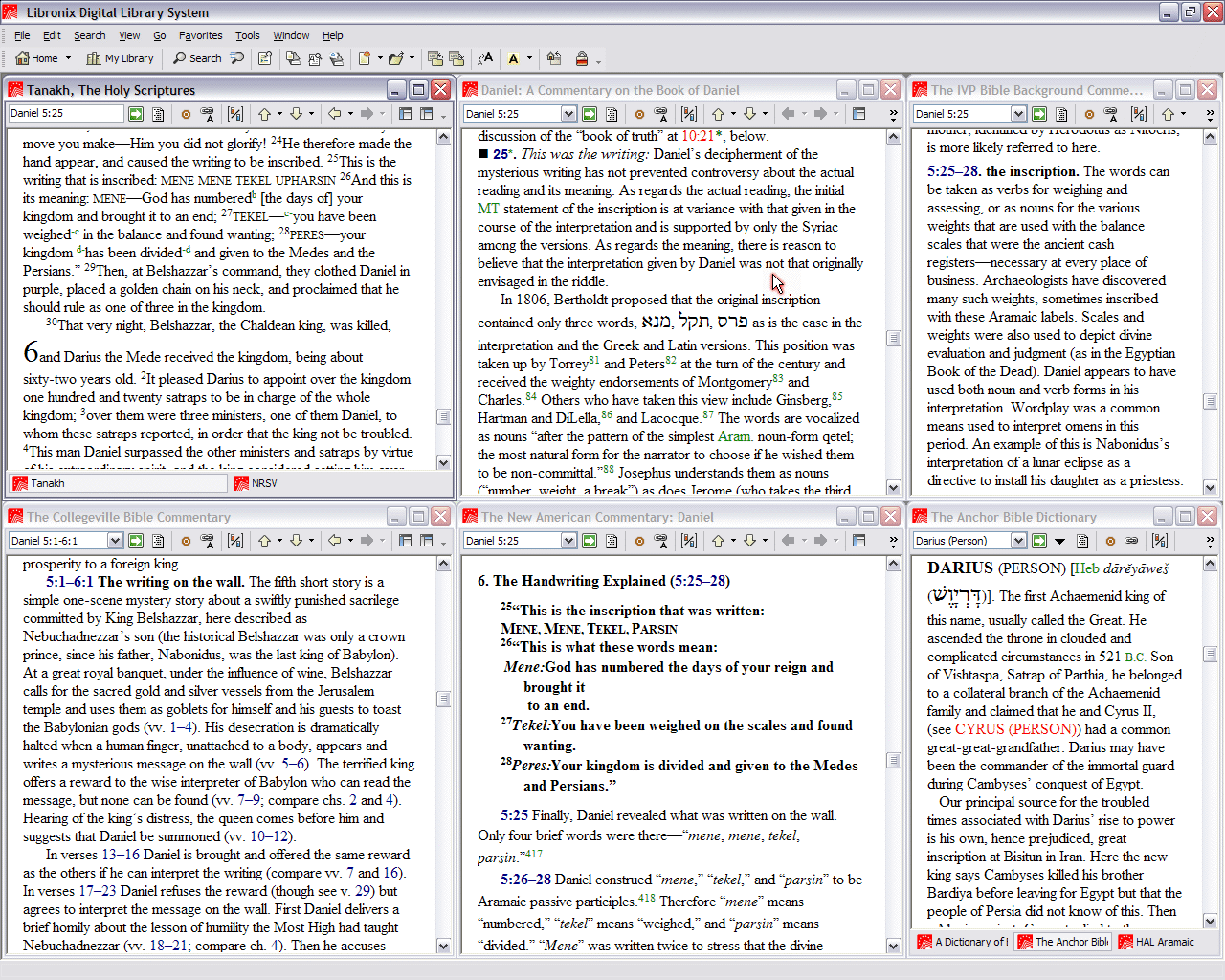
After a long beta cycle that began in 1999,[5] the LLS was replaced by the Libronix Digital Library Systems (or Libronix DLS) in 2001.[6] This was a 32-bit application (LLS was 16-bit) and had been rewritten from the ground up in a more modular fashion that made it easier to add future expansions. As with all other versions of Logos Bible Software, it was offered as a free update to existing customers. In terms of branding, Libronix Digital Library System refers to the software itself, whilst Logos Bible Software Series X was used for packages that included both the software and electronic Biblical studies resources.
Version 2 of Libronix DLS appeared in July 2003 as Logos Bible Software Series X 2.0. This added support for documents such as notes and word lists, visual filters (which allow users to create rules to add highlighting and markup to resources automatically), and a graphical query editor.[7] Version 3 was launched in June 2006 and introduced reverse-interlinear Bibles, the Bible Word Study tool, and syntax searches.[8] The Series X name was dropped, and the software was known simply as Logos Bible Software 3. In March 2008 an alpha version of Logos Bible Software for Mac was released for testing,[9] with the retail edition shipping in December.[10] This was known as Logos Bible Software for Mac 1.0, and although based on the Windows version, full parity was never achieved, even with versions 1.1 and 1.2 which shipped in 2009.
However, on November 2, 2009, Logos announced Logos Bible Software 4 for Windows, along with an early alpha version of Mac edition and a cut-down iPhone version. Like the original release of the Libronix Digital Library System, the application had been substantially rewritten, and featured a very different graphical user interface than its predecessor.[11] Crucially, once the Mac version was completed, both editions of the software would be almost identical in function, and settings, documents and resources would seamlessly sync between the different versions. The Mac version reached beta in July 2010,[12] and was released in September 2010.[13] Various updates later came to both platforms, with version 4.1 (October 2010, Windows only) adding sentence diagramming and print/export,[14] 4.2 (December 2010 on Windows, March 2011 on Mac) adding various minor features and bug fixes,[15] 4.3 (August 2011) adding Personal Books to allow users to add their own content,[16] 4.5 (January 2012) adding improved notes and highlighting[17] (4.4 was skipped), and 4.6 (August 2012) offering bug fixes and a few tweaks.
Logos Bible Software 5 was released for both Mac and Windows in November 2012,[18] with an emphasis on connecting disparate features and databases, making Bible study easier and more efficient.[19] Datasets and tagging added to Bibles meant users could now explore the roots of words and their sense, and the Sermon Starter Guide and Topical Guide made accessing Bible topics much simpler and quicker. Logos 5.1 (July 2013) added read-along audio and a new topic layout,[20] with several more minor improvements in 5.2 (November 2013).[21]
Logos Bible Study Software Mac And Cheese
Logos Bible Software 6 was released at the end of October 2014,[22] and became the first version to support 64-bit architecture. It too added a number of new datasets and features, including Ancient Literature cross-references, Cultural Concepts, original manuscript images, multimedia and the new Factbook that attempted to integrate the increasing number of databases to an even greater extent than was possible in Logos 5. Logos 6 also integrates with the Send to Kindle service provided by Amazon.
Logos Bible Software 7 was released towards the end of August 2016. Features added with this full version include, Sermon Editor, Course Tool, Figurative Language (interactive), Hebrew Grammatical Constructions, Longacre Genre Analysis, Sentence Types of the New Testament Dataset, Quickstart Layouts, Speech Acts, An Empty Tomb (interactive), Exploring Biblical Manuscripts.
Logos Bible Software 8 was released at the end of October 2018.
Mobile versions[edit]
An iPhoneapp was released alongside Logos 4 in November 2009. It allows users to access most of their Logos resources on the iPhone, with basic search and study features. Resources can be accessed over the cloud, or downloaded onto the device for offline access. Native iPad support was added with version 1.4 in April 2010.[23] Version 2.0 (January 2012) added notes, highlights and inline footnotes.[24] Version 3.0 (August 2012) added reading plans and community notes,[25] and version 4.0 a new UI updated for iOS 7. A topic guide was added in 4.3 (June 2014), and a scrolling view in 4.4 (December 2014). The app is now available in several 'flavours'. In addition to the standard Logos Bible Software app, other very similar apps exist under the Faithlife Study Bible, Vyrso, Verbum and Noet brands. These apps offer similar functionality, different branding, and a slightly different UI. The iOS app was awarded the DBW Publishing Innovation Award in 2011.
An Android app entered a public alpha in May 2011,[26] with a beta in July,[27] and 1.0 released a year later. The initial release allowed little more than the reading of Logos books, so version 2.0 followed quickly in August 2012, which added notes, highlighting, reading plans, Bible Word Study, the Passage Guide and a split-screen view. This brought much closer parity with the iOS app,[28] and future development has continued along similar lines to the iOS version.
Rebranded versions[edit]
Faithlife Corporation also produces two rebranded versions of Logos Bible Software with almost identical functionality. Verbum is aimed at Roman Catholics (and adds databases of Catholic topics and Saints, and more data from the Deuterocanonical Books), and Noet is for those undertaking scholarly work in the humanities, particularly the classics and philosophy.
Reception[edit]
Each version of Logos Bible Software has generally been received very positively by reviewers and Christian leaders. It is frequently praised for being user-friendly,[29] having the largest number of available resources of any comparable software,[30][31] and offering unique tools and datasets not found in any comparable products.[32] However, it has also received some criticisms for its high cost[33] and lack of speed when compared with other Bible software packages.[31]
Notes[edit]
- ^The software itself is freeware. Most resources and datasets are paid for add-ons.
References[edit]
Logos Bible Software Install
- ^Gons, Phillip ‘Phil’ (April 16, 2004). 'Logos Research Systems Commissions New Hebrew-English Interlinear Bible'. Logos Bible Software. Retrieved June 13, 2010.
- ^'Logos Bible Software rebrands as Faithlife'. October 7, 2014. Archived from the original on March 4, 2016.
- ^'High-tech survivors'. Whatcom County Business Pulse. Archived from the original on 2006-08-23. Retrieved 2006-09-27.
- ^Harris, III, W Hall (February 6, 2008). 'Bible Software History 101'. Retrieved June 13, 2010.
- ^'Code Name 'Titus' — The Future of the Logos Library System'. March 29, 1999. Archived from the original on May 8, 1999. Retrieved January 5, 2015.CS1 maint: unfit url (link)
- ^'Tip from CS: Update from the Logos Library System to Libronix'. January 6, 2009. Retrieved January 3, 2015.
- ^'Logos Bible Software Series X v2.0'. 7 July 2003. Archived from the original on July 7, 2003. Retrieved 5 January 2015.CS1 maint: unfit url (link)
- ^'Introducing.. Logos Bible Software 3!'. 15 June 2006. Archived from the original on June 15, 2006. Retrieved 3 January 2015.CS1 maint: unfit url (link)
- ^'Macintosh Logos Bible Software Hits Alpha'. 14 March 2008. Retrieved 3 January 2015.
- ^'The Answer to Your Question Is 'Now'!'. 5 December 2008. Archived from the original on April 1, 2009. Retrieved 3 January 2015.CS1 maint: unfit url (link)
- ^'Logos Bible Software 4.0 Launched!'. Bible Software Review Weblog. 2 November 2009. Retrieved 3 January 2015.
- ^'Beta 1 & 2 Release Notes'. Logos Bible Software Forums. 23 July 2010. Retrieved 3 January 2015.
- ^'Mac Release Notes and History'. Retrieved 3 January 2015.
- ^'Logos 4.1'. Retrieved 3 January 2015.
- ^'Logos 4.2'. Retrieved 3 January 2015.
- ^'Free Personal Book Builder Ships with New Logos 4 Update!'. 10 August 2011. Retrieved 3 January 2015.
- ^'Updates to Highlights and Notes Coming in 4.5'. 23 January 2012. Retrieved 3 January 2015.
- ^'Logos 5 has arrived: a smarter connection to the Word'. November 5, 2012. Archived from the original on March 4, 2016.
- ^'Introducing Logos Bible Software 5'. 1 November 2012. Retrieved 3 January 2015.
- ^'Introducing Logos 5.1'. 2 July 2013. Retrieved 3 January 2015.
- ^'Logos 5.2'. Retrieved 3 January 2015.
- ^'Logos 6 arrives'. Reformation21. 27 October 2014. Retrieved 3 January 2015.
- ^'Review: Logos Bible Software for iPad v. 1.4'. This Lamp. 18 April 2010. Retrieved 3 January 2015.
- ^'Logos for iOS 2.0.1 Release Notes'. 27 January 2012. Retrieved 3 January 2015.
- ^'iOS Reader Suite 3.0.0 Release Notes'. 29 August 2012. Retrieved 3 January 2015.
- ^'Logos for Android Alpha 4'. 14 May 2011. Retrieved 3 January 2015.
- ^'Logos for Android released'. 4 July 2011. Retrieved 3 January 2015.
- ^'Logos Brings More Parity Between Android and iOS Bible Apps'(PDF). Christian Computing Magazine. August 2012. Archived from the original(PDF) on 23 September 2015. Retrieved 3 January 2015.
- ^Barrett, Charles M. (April 2013). 'Logos Bible Software 5'. Themelios.
- ^Challies, Tim (Fall 2006). 'Logos Bible Software 3'. The Journal of Modern Ministry.
- ^ abTabb, Brian J. (April 2014). 'Logos Bible Software 5 Platinum'. Themelios.
- ^Parker, David (July 2003). 'Logos Bible Software Series X'. Evangelical Review of Theology.
- ^Naselli, Andrew David (April 2014). 'Baker Academic Biblical Studies Bundle'. Themelios.
External links[edit]
Logos Bible Study Software For Mac
Logos Bible Software official websites: